Home › Blog › Why Do Women Gain Weight During Menopause?
Causes & LifestyleWhy Do Women Gain Weight During Menopause? Causes and Lifestyle Fixes
| The problem | Menopause weight gain is driven by falling estrogen plus lost muscle, a slower burn, and poorer sleep and stress arriving together. |
| Where it lands | Storage shifts from the hips and thighs toward the abdomen, so the shape changes even when the scale barely moves. |
| What helps | Protein at every meal, strength training twice a week, daily steps, better sleep and stress care — plus sensible plant-based support. |
If the number on the scale started creeping up in your mid-forties or early fifties — despite eating much the way you always have — you are asking one of the most common and most frustrating questions in women’s health: why do women gain weight during menopause? You are not imagining it, and it is not a lack of discipline. Menopause weight gain is a predictable result of several changes happening at once, most of them driven by shifting hormones and the ordinary effects of getting older.
The reassuring part is that once you understand the causes, the fixes stop feeling mysterious. This guide explains, in plain language, why the body behaves differently in the menopausal transition — and the everyday habits, foods and routines that genuinely help you manage your weight through it and beyond.
What actually happens during the menopausal transition
Menopause is not a single day; it is a transition that usually unfolds over several years. Doctors mark menopause itself as twelve months without a period, but the years leading up to it — perimenopause — are when hormones swing the most and when many women first notice their body changing. (Climacteric, 2012)
Estrogen falls
The headline change is a decline in estrogen. Beyond its role in the menstrual cycle, estrogen influences where the body prefers to store fat. When levels were higher, fat tended to sit on the hips and thighs (the classic pear shape). As estrogen drops, the body shifts storage toward the abdomen — and toward deeper visceral fat packed around the organs rather than the softer, pinchable kind.
Muscle quietly declines
From our thirties onward, we lose a little muscle each decade unless we actively train — a process called sarcopenia that often accelerates around menopause. Muscle is metabolically active tissue, so losing it lowers the number of calories you burn at rest. Less muscle plus the same plate quietly tips into a surplus.
The resting burn slows
Between lost muscle and lower activity, the calories you burn just existing — your basal metabolic rate — edge downward. This is why women often say the diet that worked effortlessly at 35 does nothing at 52. For the bigger picture on age-related changes, our companion guide on how to speed up a slow metabolism pairs closely with this one.
Why menopause weight settles around the middle
Perhaps the most striking change is not how much weight appears but where. Many women who never carried weight around their waist suddenly find it there. That shift toward abdominal storage is largely down to the drop in estrogen, and it matters because visceral fat is the type most responsive to stress hormones, sleep and refined carbohydrates. If you want to understand that middle-focused pattern in more depth, our article on what causes belly fat and how to reduce it goes deeper on the two kinds of belly fat. (Obesity (Silver Spring), 2010)
The everyday factors that make it worse
Hormones set the stage, but daily life usually turns up the volume. Most women in the transition have three or four of these working against them at once:
- ✓ Broken sleep. Hot flushes and night sweats fragment sleep, and short sleep raises hunger hormones and cravings the next day. Our guide on how poor sleep causes weight gain explains this loop.
- ✓ Higher stress. Midlife often stacks caring responsibilities, career pressure and change. Chronic stress keeps cortisol elevated, and cortisol encourages the body to store visceral fat — see can stress and cortisol cause weight gain.
- ✓ Less daily movement. Busier, more sedentary routines shrink the background steps and fidgeting (NEAT) that once burned a surprising number of calories.
- ✓ Appetite drift. Fluctuating hormones can nudge appetite and cravings, making it easier to reach for quick carbohydrates and sweet foods.
- ✓ Under-eating protein. Many women eat too little protein to protect muscle at exactly the age when muscle needs protecting most.
Notice that willpower is not on the list. Menopause weight gain is the sum of biology and circumstance drifting in the same direction — which means adjusting those inputs changes the outcome.
Lifestyle fixes that actually help
The good news: the levers still work. They simply need to be more deliberate than they did twenty years ago. None of these is dramatic on its own, but stacked together and repeated, they move the needle. (Climacteric, 2024)
1. Anchor every meal with protein
Protein is the most filling macronutrient and it protects the muscle that keeps your metabolism ticking — the single most important goal in menopause. Aim for a palm-sized portion at each meal: eggs, fish, poultry, Greek yogurt, tofu, beans or lentils. Front-loading protein at breakfast also steadies appetite for the rest of the day.
2. Lift something heavy twice a week
Resistance training is the most reliable way to preserve and rebuild the metabolically active muscle you lose in the transition. You do not need a gym — bodyweight squats, push-ups, lunges and resistance bands at home all count. Strength work also supports bone density, which matters more after menopause.
3. Walk more than you think you need to
Background movement is one of the biggest swings in daily calorie burn. Aim for 7,000–10,000 steps: take calls on your feet, park farther away, and walk for ten minutes after meals to help steady blood sugar.
4. Protect your sleep on purpose
Sleep is genuinely harder in menopause, which is exactly why it deserves attention. Keep the bedroom cool, dim screens an hour before bed, and hold a consistent wake time. Treating seven to nine hours as part of your weight plan — not a luxury — pays off in fewer next-day cravings.
5. Lower the background stress
You cannot delete midlife stress, but you can blunt it: a daily walk, slow breathing, time outdoors and protected downtime all help keep cortisol from staying stuck high.
6. Cut the liquid sugar first
Sweetened coffees, juice and alcohol are the easiest calories to over-consume without feeling full. Swapping most of them for water, sparkling water, unsweetened tea or black coffee is often the highest-impact single change.
Support your routine with Valiora
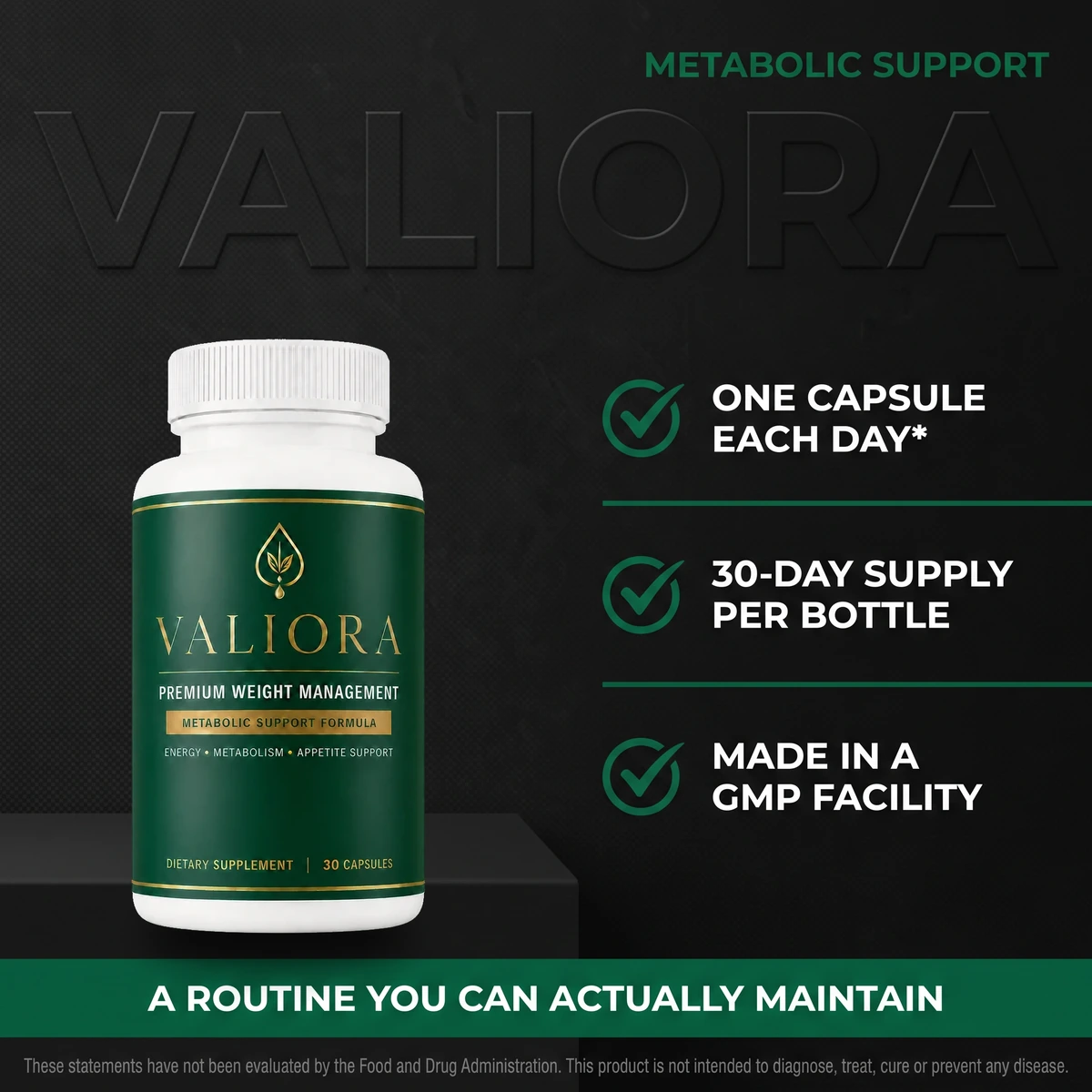
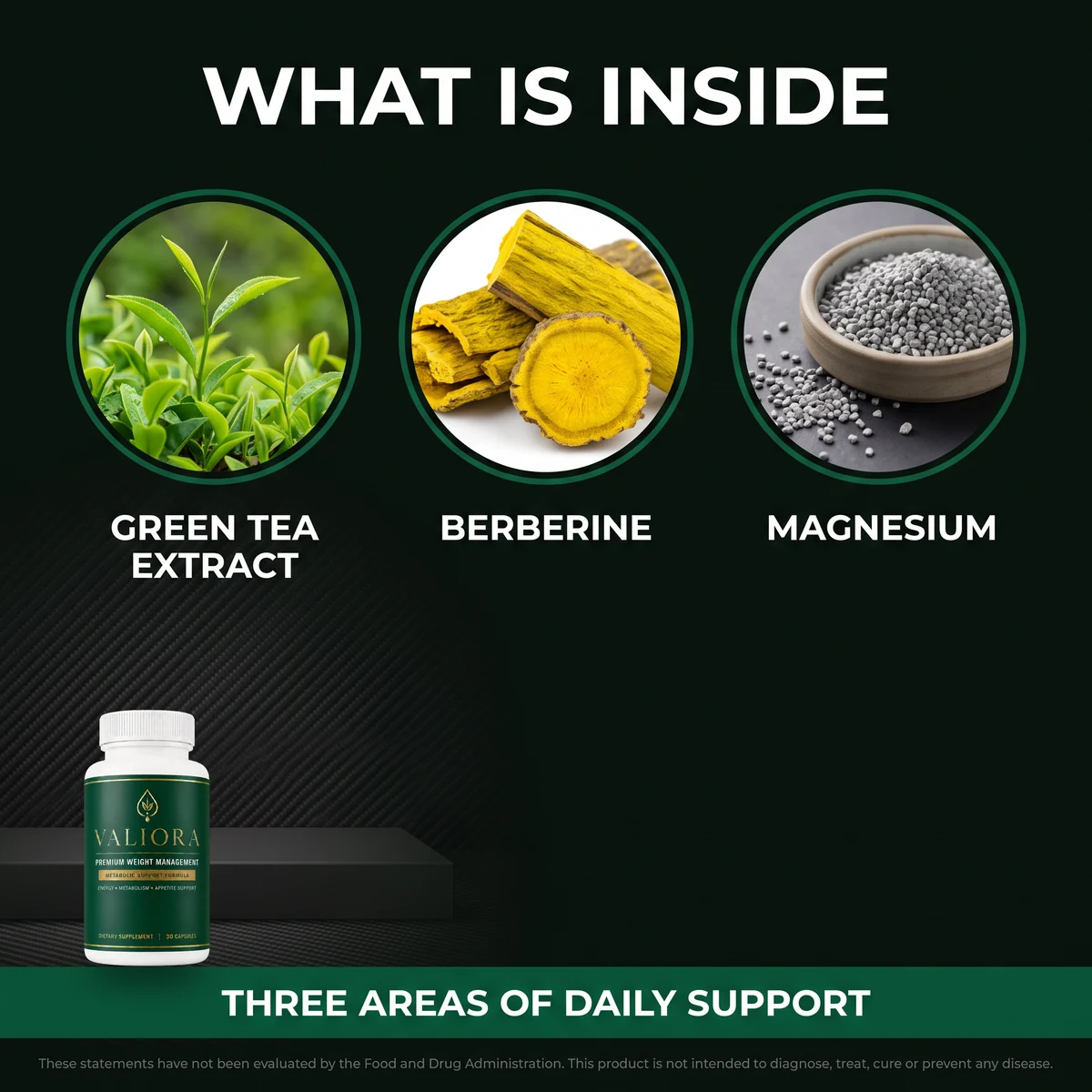
Valiora brings green tea extract, berberine, magnesium and other plant-based actives into one easy daily capsule — designed to complement the protein, movement and sleep habits above. Backed by a 60-day money-back guarantee.
 See Valiora Packages
Where a supplement fits in
Let’s be honest: no capsule reverses menopause weight gain on its own, and any trustworthy guide will say so. What a well-formulated supplement can do is make a good routine a little easier to keep up on the days when sleep was short and motivation is thin. Several plant-based ingredients are popular in metabolic formulas for their traditional use — green tea extract is rich in catechins associated with metabolism, berberine is widely used to support healthy blood-sugar balance, chromium supports normal macronutrient metabolism, and magnesium supports energy production and restful sleep. A once-daily formula like Valiora packages these together so the support is simple to maintain alongside the habits that do the heavy lifting.
The mindset that works: the supplement supports your effort; your effort is still the engine. If your weight has been stuck despite doing the right things, our practical guide on how to break a weight loss plateau is a useful next read.
A realistic starting plan
If the full list feels like a lot, do not try to change everything at once. Pick two habits this week — say, protein at breakfast and two short strength sessions — and let them become automatic before adding more. Progress through menopause is usually slower than it was in your thirties, so measure success in months and in how your clothes fit, not in daily weigh-ins. For the wider picture on how a simple daily routine fits together, the Valiora homepage lays it out.
The takeaway: menopause weight gain is real, common and workable. It is biology plus everyday inputs, not a personal failing. Protect your muscle, move across the day, sleep and stress-manage on purpose, eat enough protein — keep it consistent, and your body responds on its own timeline.
FAQ
Why do women gain weight during menopause?
Falling estrogen shifts where the body stores fat toward the abdomen, while a natural loss of muscle and a slower resting burn mean the same eating habits now add weight. Poorer sleep, higher stress and less daily movement usually pile on at the same time, so it is rarely one single cause.
Why does menopause weight settle around the belly?
Before menopause, higher estrogen tends to steer fat toward the hips and thighs. As estrogen drops, storage shifts toward deeper abdominal (visceral) fat around the organs, which is why the pattern often changes from pear-shaped to more weight around the middle.
Can you lose weight during and after menopause?
Yes. The levers still work, they just need to be more deliberate: enough protein, two or three strength sessions a week to protect muscle, plenty of daily steps, better sleep and lower stress. Progress is often slower than in your thirties, so consistency matters more than intensity.
Do supplements help with menopause weight gain?
No supplement reverses menopause weight gain on its own. Plant-based ingredients such as green tea extract, berberine and magnesium are traditionally linked to metabolism and healthy blood-sugar balance, and they work best alongside protein, movement, sleep and stress management rather than instead of them.
Should I eat less to counter menopause weight gain?
Cutting calories too hard usually backfires: it signals the body to conserve energy and burn muscle, the opposite of what you want. Aim for a moderate, sustainable deficit built mostly from more protein, fewer liquid calories and more daily movement rather than from eating very little.
References
- Understanding weight gain at menopause (Climacteric, 2012)
- Testosterone and visceral fat in midlife women: the Study of Women's Health Across the Nation (SWAN) fat patterning study (Obesity (Silver Spring), 2010)
- Understanding of and clinical approach to cardiometabolic transition at the menopause (Climacteric, 2024)
- Visceral and ectopic fat, atherosclerosis, and cardiometabolic disease: a position statement (Lancet Diabetes Endocrinol, 2019)
- National Institutes of Health, Office of Dietary Supplements — ingredient fact sheets.
Every citation above was checked against its PubMed record on 3 September 2026. Research on an individual nutrient or habit is not evidence about any finished product.
† These statements have not been evaluated by the FDA. This product is not intended to diagnose, treat, cure or prevent any disease. This article is for general information only and is not medical advice. Affiliate disclosure: this is an independent guide, not the manufacturer. Some links here are affiliate links and we may earn a commission — at no extra cost to you — if you buy through them.