Home › Blog › What Causes Belly Fat
Causes & LifestyleWhat Causes Belly Fat? Everyday Causes and Lifestyle Fixes
| The problem | Fat settles around the middle when calories, stress, sleep and hormones drift in the wrong direction at once. |
| Main causes | Low activity, too much refined sugar, poor sleep, chronic stress and the natural drop in muscle with age. |
| What helps | Protein at every meal, daily steps, strength training, better sleep, stress management — plus sensible plant-based support. |
If your jeans feel tighter around the waist even though the rest of you hasn’t changed much, you’re asking a very common question: what causes belly fat, and why does it seem to land there first and leave last? The honest answer is that belly fat is rarely about one thing. It’s the visible result of several everyday habits — food, movement, sleep, stress and time — drifting in the same direction at once. The good news is that those are exactly the levers you can adjust.
This guide breaks down the real, everyday causes of belly fat in plain language, then walks through the lifestyle routines that help you reduce it sustainably — no crash diets, no punishing workouts you’ll quit in a fortnight.
Two kinds of belly fat (and why the difference matters)
Not all belly fat is the same. Understanding the two types explains why the mirror and the tape measure sometimes tell different stories. (Lancet Diabetes Endocrinol, 2019)
Subcutaneous fat
This is the soft, pinchable layer that sits just under the skin. It’s the fat you can grab, and while most people want less of it for appearance, it is the less concerning of the two.
Visceral fat
This is the deeper fat packed around your organs. You can’t pinch it, but it’s the type most linked to metabolic health, and it is especially responsive to stress hormones, sleep and refined carbohydrates. When people describe belly fat as “stubborn,” visceral fat is usually the reason — and it’s also the type that tends to respond well once your daily habits improve.
The everyday causes of belly fat
Here are the factors that quietly stack up. Most people have three or four working against them at the same time without realising it. For women in midlife, hormonal change shifts fat storage toward the middle on its own — our guide on why women gain weight during menopause covers that. (Psychoneuroendocrinology, 2015)
- ✓ A steady calorie surplus. Small extras — a sugary coffee here, a second helping there — add up over months. The body banks the surplus, and for many people the belly is a preferred storage site.
- ✓ Refined sugar and alcohol. Both are easy to over-consume and are strongly associated with fat accumulating around the middle rather than the limbs.
- ✓ Low daily movement. A desk job plus a car plus an evening on the sofa can mean very few calories burned outside of formal exercise. That background activity matters more than most single workouts.
- ✓ Poor sleep. Short or broken sleep raises hunger hormones and cravings the next day and is directly linked to more abdominal fat over time.
- ✓ Chronic stress. Ongoing stress keeps cortisol elevated, and cortisol encourages the body to store visceral fat around the organs.
- ✓ Muscle loss with age. From our 30s onward we lose muscle unless we train, which lowers daily calorie burn and makes the same diet gain weight.
- ✓ Hormonal shifts. Changes in estrogen, testosterone and insulin sensitivity influence where the body prefers to store fat — which is why the pattern often changes with age.
Notice that willpower isn’t on the list. Belly fat isn’t a character flaw; it’s a predictable outcome of a set of conditions. Change the conditions and you change the outcome. If part of the picture for you is a burn rate that has slowed with age, our companion guide on how to speed up a slow metabolism pairs neatly with this one.
Why crunches won’t do it (the spot-reduction myth)
One of the most persistent fitness myths is that you can burn fat from a specific area by exercising it. You can’t. Sit-ups and crunches strengthen the abdominal muscles underneath, which is worthwhile, but they don’t remove the fat sitting on top. Fat is lost across the whole body when you maintain a modest, sustainable calorie deficit — and the belly comes down as part of that overall reduction, on your body’s own timeline. For some people the midsection is the last place to slim; that’s genetics, not failure.
Lifestyle fixes that actually reduce belly fat
These are the levers with the strongest track record. None are dramatic on their own, but stacked together and repeated, they move the needle. Walking is the most sustainable of these, and our guide on how many steps a day to lose weight explains how much is enough. (Circulation, 2026)
1. Anchor every meal with protein
Protein is the most filling macronutrient and it protects the muscle that keeps your metabolism ticking. A palm-sized portion at each meal — eggs, fish, poultry, Greek yogurt, beans, lentils or tofu — steadies appetite and reduces the grazing that quietly builds a surplus.
2. Cut the liquid sugar first
Sweetened drinks, fancy coffees, juice and alcohol are the easiest calories to over-consume because they don’t fill you up. Swapping most of them for water, sparkling water, unsweetened tea or black coffee is often the single highest-impact change for a shrinking waistline.
3. Walk more than you think you need to
Background movement — the steps, standing and fidgeting researchers call NEAT — is one of the biggest swings in daily calorie burn. Aim for 7,000–10,000 steps: take calls on your feet, park farther away, and walk for ten minutes after meals to help steady blood sugar.
4. Add two or three short strength sessions
Resistance training rebuilds the metabolically active muscle you lose with age. You don’t need a gym — bodyweight squats, push-ups, lunges and resistance bands at home count. More muscle means a higher resting burn, day and night.
5. Treat sleep as part of the plan
Aim for seven to nine hours. Under-sleeping raises the hunger hormone ghrelin, dulls the fullness hormone leptin, and leaves you with less energy to move — a triple hit for the belly.
6. Lower the background stress
You can’t eliminate stress, but you can blunt it: a daily walk, a few minutes of slow breathing, time outdoors and protected downtime all help keep cortisol from staying stuck high. If constant hunger is part of your day, our guide on why you feel hungry even after eating digs into the appetite side of the equation.
Support your routine with Valiora
Valiora brings green tea extract, berberine, chromium and other plant-based actives into one easy daily capsule — designed to complement the food, movement and sleep habits above. Backed by a 60-day money-back guarantee.
 See Valiora Packages
Where a supplement fits in
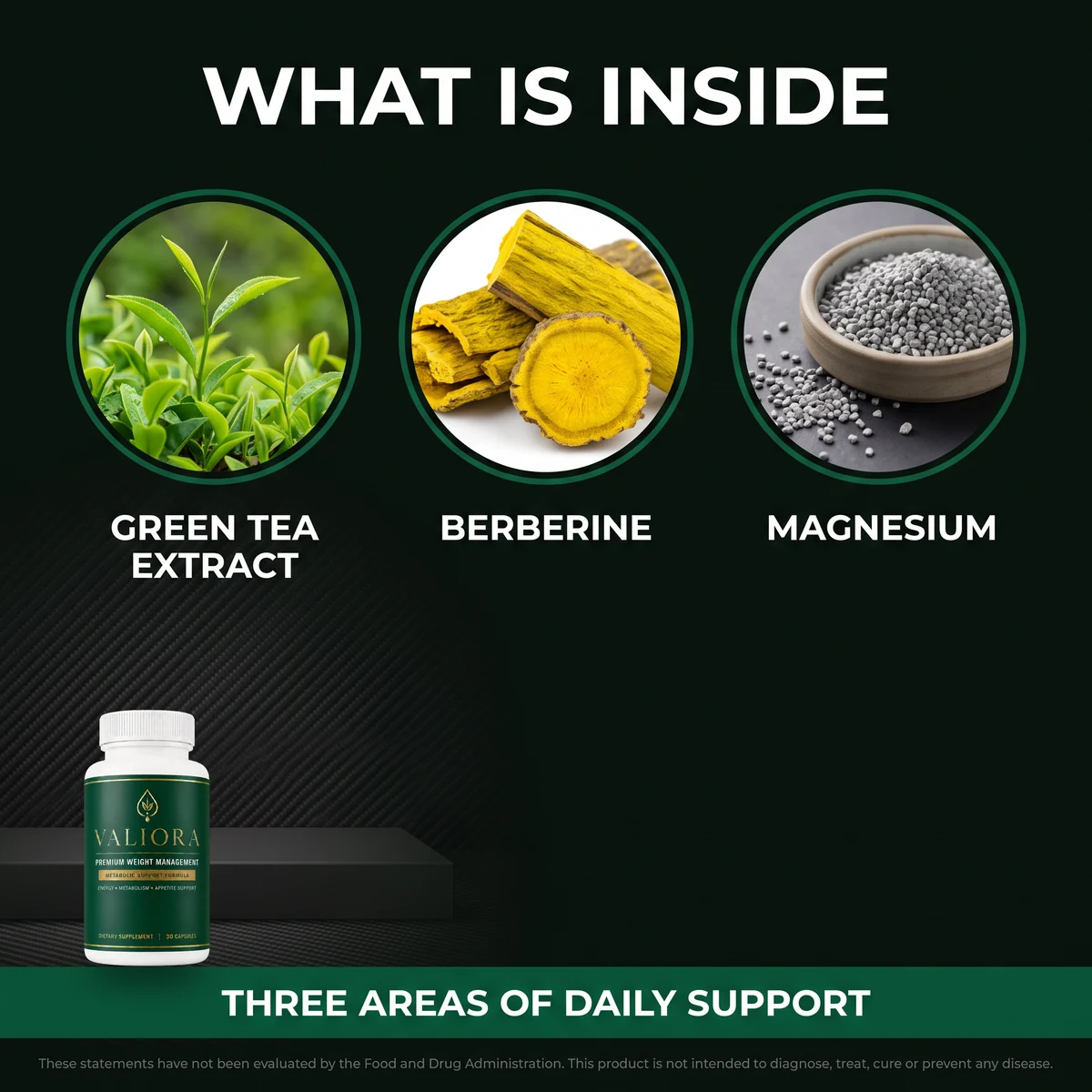
Let’s be clear: no capsule burns belly fat on its own, and any honest guide will say so. What a well-formulated supplement can do is make a good routine a little easier to keep up. Several plant-based ingredients are popular in metabolic formulas for their traditional use — green tea extract is rich in catechins associated with metabolism, berberine is widely used to support healthy blood-sugar balance, chromium supports normal macronutrient metabolism, and magnesium supports energy production. A once-daily formula like Valiora packages these together so the support is simple to maintain alongside the habits that do the heavy lifting.
The mindset that works: the supplement supports your effort; your effort is still the engine. If sugar is your particular weak spot in the evening, pair this with our practical guide on how to stop sugar cravings at night.
A simple starting plan
If the full list feels like a lot, don’t try to do everything at once. Pick two changes this week — say, protein at breakfast and a ten-minute walk after dinner — and let them become automatic before adding more. Belly fat took months or years to arrive; giving your body a few steady months to respond is realistic and far more likely to last. For the bigger picture on daily habits and momentum, the Valiora homepage lays out how the everyday routine fits together.
The takeaway: belly fat is the sum of everyday inputs, not a personal failing. Adjust the inputs — more protein, fewer liquid calories, more steps, better sleep, lower stress — keep them consistent, and the middle usually follows.
FAQ
What actually causes belly fat?
Belly fat builds up when you take in more energy than you use, but several everyday factors push it toward your middle: too much refined sugar and alcohol, low daily movement, poor sleep, chronic stress and the natural loss of muscle as we age. Hormones and genetics decide where the body prefers to store it.
Can you target belly fat specifically?
No. Spot reduction is a myth — crunches build the muscle under the fat but do not burn the fat on top of it. You lose fat across the whole body when you keep a modest calorie deficit, and the belly usually shrinks as part of that overall change.
Why is belly fat so stubborn?
Deep abdominal (visceral) fat responds to hormones like cortisol and insulin, which is why stress, broken sleep and sugary diets make it cling. Consistency with sleep, movement and food matters more than any single intense effort.
Do supplements reduce belly fat on their own?
No supplement melts belly fat by itself. Plant-based ingredients such as green tea extract, berberine and chromium are traditionally linked to metabolism and healthy blood-sugar balance, and they work best alongside the habits above, not instead of them.
References
- Visceral and ectopic fat, atherosclerosis, and cardiometabolic disease: a position statement (Lancet Diabetes Endocrinol, 2019)
- Hypothalamic-pituitary-adrenal axis dysregulation and cortisol activity in obesity: A systematic review (Psychoneuroendocrinology, 2015)
- Lifestyle-Induced Visceral Fat Loss as a Key Target for Durable Cardiometabolic Health: MRI-Assessed 5- and 10-Year Follow-Up After 2 Clinical Trials (Circulation, 2026)
- Effects of sleep restriction on metabolism-related parameters in healthy adults: A comprehensive review and meta-analysis of randomized controlled trials (Sleep Med Rev, 2019)
- National Institutes of Health, Office of Dietary Supplements — ingredient fact sheets.
Every citation above was checked against its PubMed record on 3 September 2026. Research on an individual nutrient or habit is not evidence about any finished product.
† These statements have not been evaluated by the FDA. This product is not intended to diagnose, treat, cure or prevent any disease. This article is for general information only and is not medical advice. Affiliate disclosure: this is an independent guide, not the manufacturer. Some links here are affiliate links and we may earn a commission — at no extra cost to you — if you buy through them.